



Our project in Nakivale
Overview
Uganda is the largest refugee-hosting country in Africa and ranks among the five countries worldwide that host the highest numbers of refugees and asylum seekers. The East African nation pursues an open-door policy: newly arrived people are allocated a plot of land, are permitted to work, and do not live in isolated, closed camps, but rather in open, settlement-like communities alongside the local population. Uganda is currently home to around 1.9 million refugees.
Located in southwestern Uganda, the Nakivale Refugee Settlement is the country’s largest and at the same time oldest refugee settlement. At the end of 2025, around 273,000 refugees were living there. Most originate from conflict-affected and crisis-stricken regions in neighboring countries, particularly the Democratic Republic of the Congo, South Sudan, Sudan, Burundi, Rwanda, Ethiopia, Somalia, and Eritrea.


In recent years, the Ugandan government has faced major challenges in sustaining this system financially, as many international donor countries have drastically reduced their support. Cuts to key international aid programs, particularly those funded through the United States Agency for International Development (USAID), have further exacerbated the situation. While the number of newly arriving refugees continues to rise, the amount of available agricultural land is decreasing, and both food rations and water resources are becoming increasingly scarce. The healthcare system is under significant pressure to provide adequate medical care for everyone. There are frequent shortages of healthcare personnel, medicines, and medical equipment, while demand for healthcare services continues to grow steadily due to ongoing population growth.
As many international non-governmental organizations have withdrawn completely, a substantial gap in essential services has emerged. We aim to help close this gap through a new project.
Sustainable Strengthening of Healthcare Services in Nakivale
Against the backdrop of growing humanitarian and public health challenges, Swiss Doctors has launched a new project to sustainably strengthen the healthcare system in the Nakivale Settlement. The objective of this project is to improve medical care for both the refugees living there and the local population in a targeted and sustainable manner.
Uganda is the largest refugee-hosting country in Africa and ranks among the five countries worldwide that host the highest numbers of refugees and asylum seekers. The East African nation pursues an open-door policy: newly arrived people are allocated a plot of land, are permitted to work, and do not live in isolated, closed camps, but rather in open, settlement-like communities alongside the local population. Uganda is currently home to around 1.9 million refugees.
Located in southwestern Uganda, the Nakivale Refugee Settlement is the country’s largest and at the same time oldest refugee settlement. At the end of 2025, around 273,000 refugees were living there. Most originate from conflict-affected and crisis-stricken regions in neighboring countries, particularly the Democratic Republic of the Congo, South Sudan, Sudan, Burundi, Rwanda, Ethiopia, Somalia, and Eritrea.
In recent years, the Ugandan government has faced major challenges in sustaining this system financially, as many international donor countries have drastically reduced their support. Cuts to key international aid programs, particularly those funded through the United States Agency for International Development (USAID), have further exacerbated the situation. While the number of newly arriving refugees continues to rise, the amount of available agricultural land is decreasing, and both food rations and water resources are becoming increasingly scarce. The healthcare system is under significant pressure to provide adequate medical care for everyone. There are frequent shortages of healthcare personnel, medicines, and medical equipment, while demand for healthcare services continues to grow steadily due to ongoing population growth.
As many international non-governmental organizations have withdrawn completely, a substantial gap in essential services has emerged. We aim to help close this gap through a new project.
Sustainable Strengthening of Healthcare Services in Nakivale
Against the backdrop of growing humanitarian and public health challenges, Swiss Doctors has launched a new project to sustainably strengthen the healthcare system in the Nakivale Settlement. The objective of this project is to improve medical care for both the refugees living there and the local population in a targeted and sustainable manner.
Data & Facts
Project start: July 2026
Number of volunteer doctors: Two volunteer doctors on site at any given time, serving in six-week rotations
Partner organization: Uganda Youth and Adolescents Health Forum (UYAHF)
Structure: Local staff members and volunteer doctors work in two government health facilities in Isingiro District (Ruhoko Health Centre III and Rubondo Health Centre III) within the Nakivale Refugee Settlement. In addition, a Mobile Clinic visits refugee and host communities every quarter to bring healthcare services closer to the people. Complementary peer support forums[KD1] are also organized for refugee children to help them cope with trauma.
Area of operation: Nakivale Refugee Settlement, Isingiro District


Common health conditions: Malaria, respiratory diseases, nutrition-related illnesses, cholera
Project objectives:
- Improve outpatient care, antenatal and postnatal services, and healthcare provision for children and adolescents.
- Establish Village Health Teams to conduct home visits and deliver preventive health education and awareness activities.
- Strengthen the capacities of healthcare personnel through training in health promotion as well as child- and adolescent-friendly healthcare services.
Target group: Vulnerable population groups with limited or no access to healthcare services
Activities:
- Medical outpatient consultations at two government health facilities (Ruhoko Health Centre III and Rubondo Health Centre III) within the refugee settlement.
- Mobile clinic services in remote refugee and host communities.
Project start: July 2026
Number of volunteer doctors: Two volunteer doctors on site at any given time, serving in six-week rotations
Partner organization: Uganda Youth and Adolescents Health Forum (UYAHF)
Structure: Local staff members and volunteer doctors work in two government health facilities in Isingiro District (Ruhoko Health Centre III and Rubondo Health Centre III) within the Nakivale Refugee Settlement. In addition, a Mobile Clinic visits refugee and host communities every quarter to bring healthcare services closer to the people. Complementary peer support forums[KD1] are also organized for refugee children to help them cope with trauma.
Area of operation: Nakivale Refugee Settlement, Isingiro District
Common health conditions: Malaria, respiratory diseases, nutrition-related illnesses, cholera
Project objectives:
- Improve outpatient care, antenatal and postnatal services, and healthcare provision for children and adolescents.
- Establish Village Health Teams to conduct home visits and deliver preventive health education and awareness activities.
- Strengthen the capacities of healthcare personnel through training in health promotion as well as child- and adolescent-friendly healthcare services.
Target group: Vulnerable population groups with limited or no access to healthcare services
Activities:
- Medical outpatient consultations at two government health facilities (Ruhoko Health Centre III and Rubondo Health Centre III) within the refugee settlement.
- Mobile clinic services in remote refugee and host communities.
Outpatient Consultations
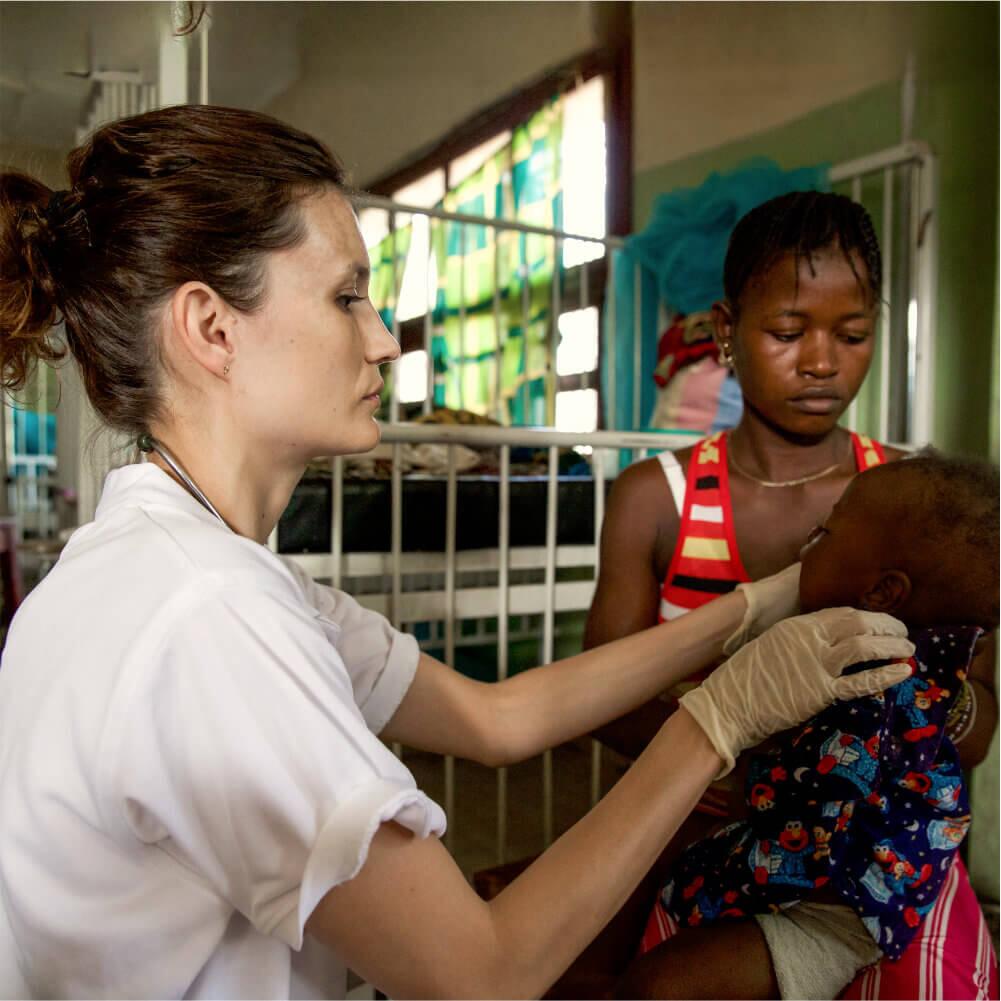
To sustainably strengthen healthcare services for the population, outpatient consultations are offered at two government health facilities in Isingiro District. During these consultations, refugees and members of host communities have the opportunity to access medical advice and treatment. At the same time, the involvement of volunteer doctors helps reduce the workload of local healthcare professionals, who manage a high volume of cases every day.


Another key focus of the collaboration is knowledge exchange. Through close cooperation with local healthcare professionals, professional competencies are strengthened and practical experience is shared. This is achieved through joint patient care, hands-on training sessions, and support in the documentation and management of patients with chronic illnesses. As a result, the project not only provides short-term relief to local medical staff but also strengthens the quality of healthcare services in the long term.
To sustainably strengthen healthcare services for the population, outpatient consultations are offered at two government health facilities in Isingiro District. During these consultations, refugees and members of host communities have the opportunity to access medical advice and treatment. At the same time, the involvement of volunteer doctors helps reduce the workload of local healthcare professionals, who manage a high volume of cases every day.
Another key focus of the collaboration is knowledge exchange. Through close cooperation with local healthcare professionals, professional competencies are strengthened and practical experience is shared. This is achieved through joint patient care, hands-on training sessions, and support in the documentation and management of patients with chronic illnesses. As a result, the project not only provides short-term relief to local medical staff but also strengthens the quality of healthcare services in the long term.
Mobile Clinic
To facilitate access to healthcare services and bring healthcare closer to communities, a Mobile Clinic operates in various parts of the Nakivale Refugee Settlement. Through these outreach activities, people receive a comprehensive range of healthcare services, including antenatal and postnatal care, immunizations, family planning, nutritional screenings, trauma counseling, and health education. These services are delivered in close cooperation with government staff and health facilities.

To ensure that particularly vulnerable and hard-to-reach individuals receive appropriate support, regular home visits by trained community health workers are conducted. Through personalized care at household level, health risks can be identified early and targeted preventive measures implemented more quickly. People living with chronic conditions and other special health needs benefit especially from this close support. The home visits also help strengthen trust between healthcare professionals and the community.
To facilitate access to healthcare services and bring healthcare closer to communities, a Mobile Clinic operates in various parts of the Nakivale Refugee Settlement. Through these outreach activities, people receive a comprehensive range of healthcare services, including antenatal and postnatal care, immunizations, family planning, nutritional screenings, trauma counseling, and health education. These services are delivered in close cooperation with government staff and health facilities.
To ensure that particularly vulnerable and hard-to-reach individuals receive appropriate support, regular home visits by trained community health workers are conducted. Through personalized care at household level, health risks can be identified early and targeted preventive measures implemented more quickly. People living with chronic conditions and other special health needs benefit especially from this close support. The home visits also help strengthen trust between healthcare professionals and the community.
Mental Health
A special focus is placed on mental health. In doing so, the project responds to the high prevalence of trauma and psychological distress among both newly arrived refugees and long-term residents. In addition, forums are organized for refugee children. These protected spaces allow young children in particular to process difficult experiences in an age-appropriate way through guided play activities.

Furthermore, interactive events, health talks, and awareness sessions are conducted. These activities aim to raise awareness of health-related issues and promote healthy behaviors. Community members are actively engaged in discussions on health topics. The events also serve as a platform for addressing misconceptions, cultural beliefs, and barriers to accessing healthcare services.
A special focus is placed on mental health. In doing so, the project responds to the high prevalence of trauma and psychological distress among both newly arrived refugees and long-term residents. In addition, forums are organized for refugee children. These protected spaces allow young children in particular to process difficult experiences in an age-appropriate way through guided play activities.
Furthermore, interactive events, health talks, and awareness sessions are conducted. These activities aim to raise awareness of health-related issues and promote healthy behaviors. Community members are actively engaged in discussions on health topics. The events also serve as a platform for addressing misconceptions, cultural beliefs, and barriers to accessing healthcare services.
Training
To sustainably strengthen local healthcare structures, two-day capacity-building trainings for healthcare professionals from the District Health Teams are conducted every six months. The trainings focus on topics such as maternal and child health, the integration of mental health and psychosocial support, the management of non-communicable diseases, health promotion and education, as well as culturally sensitive communication.

In addition, Village Health Teams (VHTs) receive training once every quarter. These regular training sessions not only support continuous professional development but also provide a structured framework for sharing experiences and lessons learned from the communities.
To sustainably strengthen local healthcare structures, two-day capacity-building trainings for healthcare professionals from the District Health Teams are conducted every six months. The trainings focus on topics such as maternal and child health, the integration of mental health and psychosocial support, the management of non-communicable diseases, health promotion and education, as well as culturally sensitive communication.
In addition, Village Health Teams (VHTs) receive training once every quarter. These regular training sessions not only support continuous professional development but also provide a structured framework for sharing experiences and lessons learned from the communities.
Living Conditions
The Nakivale Refugee Settlement is one of the oldest and largest refugee settlements in Uganda. It covers an area of approximately 185 km². At the end of 2025, around 273,000 registered refugees were living there. Most originate from conflict-affected and crisis-stricken regions in neighboring countries, particularly the Democratic Republic of the Congo, South Sudan, Sudan, Burundi, Rwanda, Ethiopia, Somalia, and Eritrea. Refugees are granted access to land, are allowed to work, and live in open, settlement-style communities alongside the local population.
Nevertheless, the settlement faces significant challenges. The amount of agricultural land available per family is steadily decreasing, many soils are heavily degraded, and numerous households are unable to produce sufficient food. At the same time, water resources are limited, infrastructure remains underdeveloped in many areas, and access to markets and public services often requires long journeys.


The healthcare system is also under considerable strain. In Uganda, healthcare for refugees and host communities is provided through an integrated district-based system, whereby the same facilities serve both population groups. Given the large population size, this places substantial pressure on healthcare personnel, infrastructure, medicine supplies, and medical equipment. As the settlement's population continues to grow, demand for healthcare services is increasing accordingly.
The health situation in Nakivale is characterized by both communicable diseases and nutrition-related health conditions. Inadequate WASH (Water, Sanitation and Hygiene) infrastructure contributes to recurring outbreaks of cholera and other waterborne diseases. In addition, many people are affected by acute malnutrition. Maternal mortality rates remain high.
Despite these challenges, Nakivale is widely recognized as a place of remarkable resilience. Many refugees strive to support themselves through farming, small-scale trade, or skilled crafts. Markets, schools, and places of worship serve as important social hubs and promote peaceful coexistence among the settlement’s diverse communities.
The Nakivale Refugee Settlement is one of the oldest and largest refugee settlements in Uganda. It covers an area of approximately 185 km². At the end of 2025, around 273,000 registered refugees were living there. Most originate from conflict-affected and crisis-stricken regions in neighboring countries, particularly the Democratic Republic of the Congo, South Sudan, Sudan, Burundi, Rwanda, Ethiopia, Somalia, and Eritrea. Refugees are granted access to land, are allowed to work, and live in open, settlement-style communities alongside the local population.
Nevertheless, the settlement faces significant challenges. The amount of agricultural land available per family is steadily decreasing, many soils are heavily degraded, and numerous households are unable to produce sufficient food. At the same time, water resources are limited, infrastructure remains underdeveloped in many areas, and access to markets and public services often requires long journeys.
The healthcare system is also under considerable strain. In Uganda, healthcare for refugees and host communities is provided through an integrated district-based system, whereby the same facilities serve both population groups. Given the large population size, this places substantial pressure on healthcare personnel, infrastructure, medicine supplies, and medical equipment. As the settlement's population continues to grow, demand for healthcare services is increasing accordingly.
The health situation in Nakivale is characterized by both communicable diseases and nutrition-related health conditions. Inadequate WASH (Water, Sanitation and Hygiene) infrastructure contributes to recurring outbreaks of cholera and other waterborne diseases. In addition, many people are affected by acute malnutrition. Maternal mortality rates remain high.
Despite these challenges, Nakivale is widely recognized as a place of remarkable resilience. Many refugees strive to support themselves through farming, small-scale trade, or skilled crafts. Markets, schools, and places of worship serve as important social hubs and promote peaceful coexistence among the settlement’s diverse communities.

Training Healthcare Workers
Following our motto, “Help That Lasts,” we focus not only on providing medical care but also on training the government employees who support our project. With 80 francs, you can help fund the continuing education of a healthcare worker who can provide long-term support to the local community.