


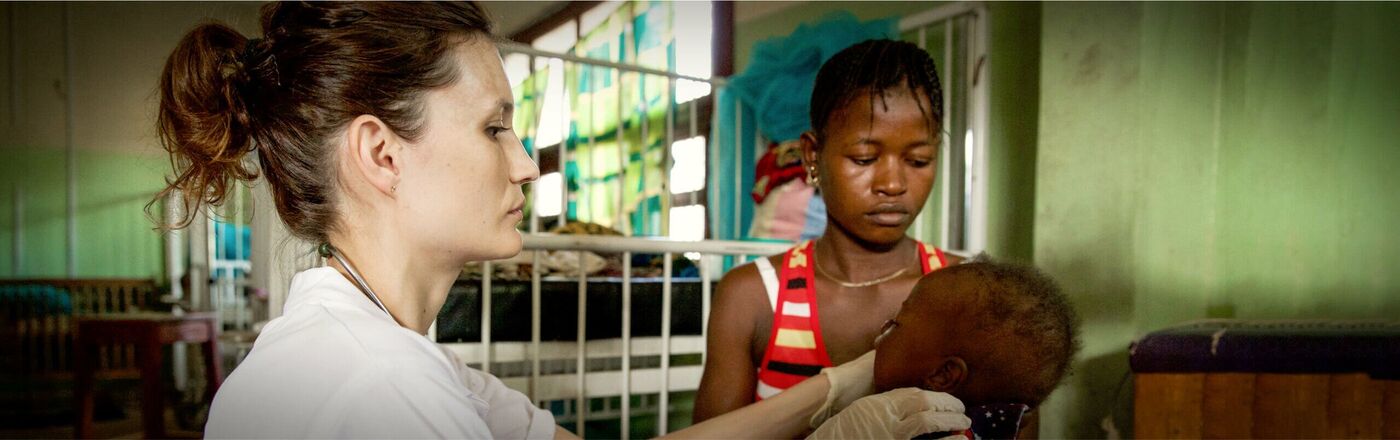
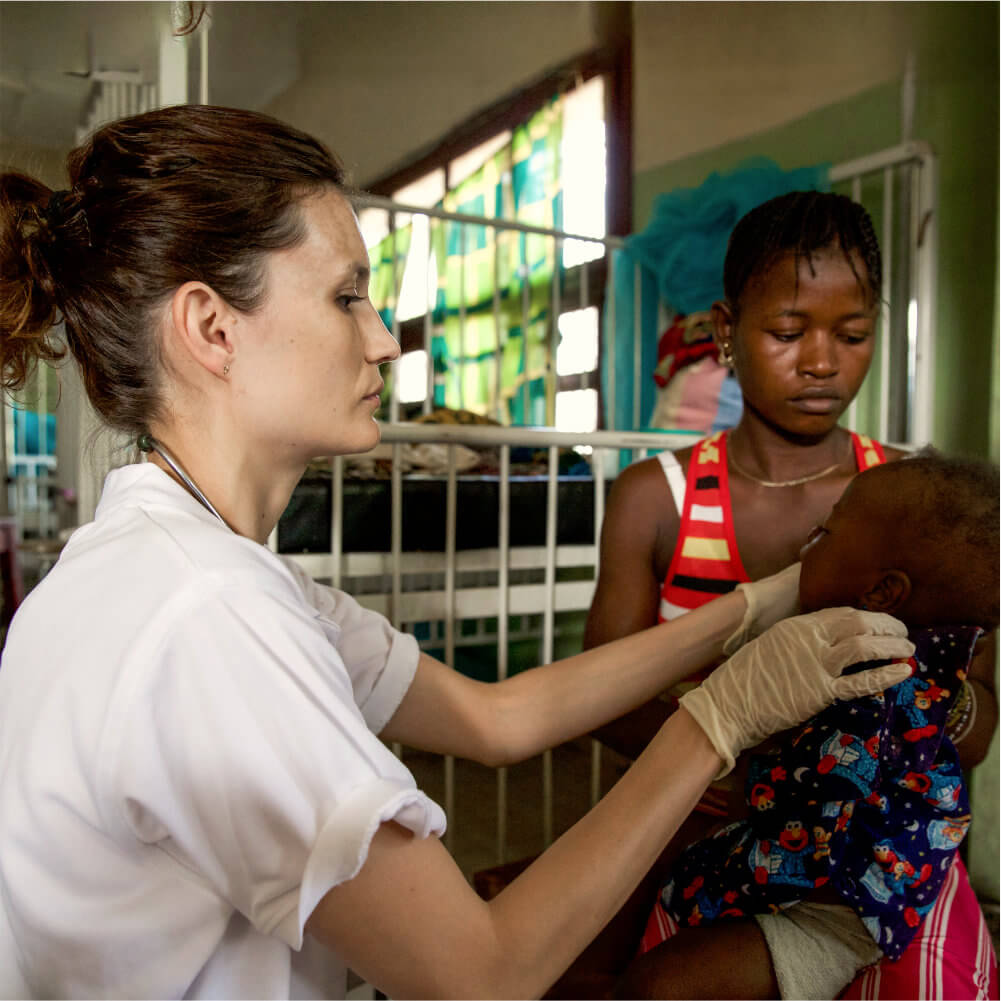
Dr. Benker: ‘Regardless of whether we share a language or a culture, people care for one another.’

© Dr. Martina Benker
Dear Martina, you went on two missions with Swiss Doctors this year. How did it come about that you went on two missions?
It was actually a relatively spontaneous turn of events. The mission to the Philippines was planned well in advance. I knew that I wanted to take time off to do volunteer work in 2025, so I applied at the beginning of 2024 and, after being accepted, went through all the preparatory steps – seminars, vaccinations and administrative tasks.
Two days before departure, I was on the mission planning platform to print out documents. I saw that there was still a slot available in India in the near future. A glance at my diary showed that I would be completely free during that time. So I applied on the spot – and four months and one mission in the Philippines later, I was already on my way to Kolkata.
What motivated you to do voluntary humanitarian work?
As a teenager, I became aware of how great the differences in living conditions are – depending on where you are born. Purely based on the lottery of birth. I also increasingly understood that our way of life and our systems contribute significantly to this gap widening. I found this injustice unacceptable.
So I began to use my privileges wherever possible to counteract the arbitrariness of the lottery of birth. I got involved with young people in my home country and later helped in various refugee camps in France and northern Greece. My decision to study medicine was also clearly motivated by this.
When I finally had enough professional experience to actually help on the ground, it was the most natural thing in the world for me to volunteer as a doctor.

You were in two different places: the Philippines and India. Can you describe your most important impressions?
First impression: there is no such thing as ‘normal’.
Before my assignment in the Philippines, I had never been to Asia, so my arrival in Manila was my first point of contact. On the way from the metropolis to our very remote project location, I saw cows and water buffalo everywhere. And so, in my naive Swiss way, I thought: there must be a large dairy industry here.
I was therefore astonished to learn that milk is a luxury import in this region. The translator explained to me that the climate and the way the animals are kept – grazing freely in the rice fields – do not allow for clean milk production.
At that moment, I realised how limited my well-intentioned ‘common sense’ is when applied to completely different realities of life.
And so I learned a simple but far-reaching lesson: there is no such thing as universal ‘normal’.
The second impression was one I already knew from my time in the refugee shelters – and yet it still touches me deeply every time: people like to help. Across cultures and countries, even when they themselves have few resources.
I experienced this most impressively on my jogging rounds. In India, I was regularly stopped by mothers who were concerned that I hadn't eaten enough and wanted to persuade me to sit down and have breakfast. Later that day, I treated them and their families at the clinic for malnutrition.
In the Philippines, almost every tricycle driver stopped to offer me a ride. On the same day, I was told that a child could not be taken to the city for a vital operation because there was no money for it. Whether we share a language or a culture, people care for one another.
There were certainly challenges too; can you describe what they were?
There were many everyday challenges: frequent power cuts, blocked roads, no drinking water or hot water from the tap, the food, the animals and insects everywhere, mosquitoes, the heat. Everything was different from home – and much of it was exhausting.
But the most difficult thing for me was something else: being aware that I was there voluntarily. I knew that at the end of my assignment, I would get on a plane and shortly afterwards be back with my own warm shower. The local people don't have that option – for them, this is everyday life, with no alternative. Coping with this discrepancy was the biggest challenge for me.